Saturday, January 26, 2019

If Only I Could Ask Her… But Which Grandmother to Ask??

Who Owned the China?

When my father passed away in the summer of 2008, he left a list directing who should receive what. I use the word "list" instead of "will" because I truly don't know for sure he had an actual will. There weren't a lot of family heirlooms other than photographs to mark the lives of his parents and grandparents - his mother's lamp, a chair, some china... are a few of the items I recall.

Along with some items that belonged to my father, I received a pair of gold plates and a partial tea set which, reportedly, belonged to my great-grandmother. On Dad’s list, he denoted that the items belonged to his grandmother. No name. That’s a problem. Which grandmother?? Henrietta Ostermann, his father’s mother? Or was it his beloved maternal grandmother, Estelle Byk? I have no idea.
The "partial" tea set
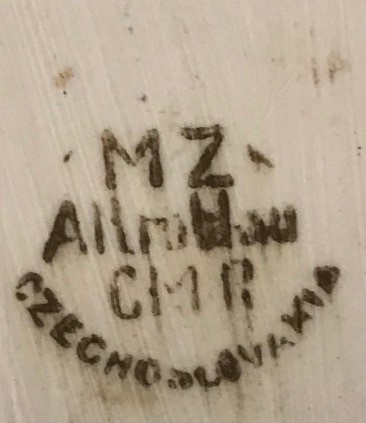
Porcelain Maker's mark
on back of tray


Beautifully gilded plate
Porcelain Maker's mark
on back of plate


As I am trying to record the provenance of “Our Stuff”, it would be helpful to know. My opportunity to speak with either of my paternal great-grandmothers is long-gone. Henrietta passed away in 1956 and Estelle in 1948. How could I determine who had owned the pieces which now sit on my dining room buffet?
Since all the items were produced in Europe maybe I could determine which grandmother’s family might have brought them to America.
The tea set (with its chipped spout and without the sugar bowl) was made by the Stara Role (Altrohlau) pottery works, originally established in 1810 by Benedict Haßlacher in the areas of Prague, Vienna, and Pest.[1] The china mark on the bottom of tray places the time of manufacture somewhere between 1909 -1922. By then, the firm had been bought by C.M. Hutschenreuther and since then the MZ Altrolau mark was used.
Barnett "Barney" SAMUEL
1882-1953
Henrietta OSTERMANN
1883-1956


Henrietta, also known as “Hattie” was born in Brooklyn, New York in 1883. Hattie’s husband, Barnett Samuel was born in Jamaica, New York in 1882. His family has been in the United States since 1859. (By the way, it’s Barney’s fault I even do genealogy! Dad told me he was “Barney the Red,” born in Ireland. Looooooong story, short answer: NOPE!)
So, clearly, that family didn’t bring the tea set to America from Europe. Hattie and Barney married in 1904 – too early to have received the tea set as a wedding gift.
Harry George KESNER
1875-1950
Estelle BYK
1885- 1948


How about Estelle and her husband, Harry George Kesner? Both Brooklyn born; Harry in 1875 or 1879 and Estelle in 1885. They married in 1906. Again, this family couldn’t have brought the set from Europe since it was made after 1909. Their 1906 marriage was too early to have received the tea set as a wedding gift.
So – that was a bust. Maybe someone went on a trip and brought the set back? Or it was a gift? Or whoever owned it purchased it at a shop? Maybe I will never know. But at least we know it was either Hattie or Estelle. I guess that’s something.
Turning to the beautiful plates, created by the porcelain factory Heinrich & Co. in Bavaria (Germany). The photos don’t do them justice. The gold encrusted rims are beautifully designed with a lacy pattern. I only have two plates, which makes me wonder if there was originally an entire set.
The china mark dates these plates as probably being made around 1901. Again, too late for any of my great-grandmothers’ families to have brought them from Europe. However, it is possible that the plates could have been purchased as part of a bridal trousseau or received as a wedding gift. But for which couple?
Both pairs of my great-grandparents married a few years after these plates were made so I can’t say definitively, but I do have an “educated” guess. Let’s look at their financial status to see if that helps narrow things down.
Click on the family tree to enlarge.

Samuel-Ostermann

The Samuels were “good people” as my husband would say. However, they lived a frugal life. Barney’s father, John Samuel was the son of cigar maker Aaron Samuel who emigrated to the United States in 1859. There wasn’t a lot of money. In fact, I found a notice in a London newspaper from 1854 in which Aaron was seeking relief from his debts. John worked as an elevator man and as a newspaper clerk. At the time of his marriage, Barney was also working as a newspaper clerk. My guess is this family didn’t have the money for fancy china.
Henrietta was a first-generation American. Her father, Eduoard Ostermann arrived in the United States from Germany in 1870. Her mother, Hanshon (Hannah) Goldschmidt was also born in Germany. Eduoard and Hanshon married in 1878, in Brooklyn, New York. So, it seems, too early for them to have been the owners of the china. Eduard worked as a “provisions dealer” – first as a butcher, then as a fish dealer. Probably a comfortable life, but did he make enough money to buy fancy china?

Byk – Kesner

Estelle’s family was a little more affluent than Barney’s. Her father, Moritz (Morris) Byk, emigrated from Germany in the mid-1800s and became a wealthy real estate dealer in Brooklyn, New York. Her mother, Paulina Falke, also emigrated from Germany in the mid-1800s. While they couldn’t have brought the china to America, they certainly had the means to purchase fancy china, especially as a wedding gift for their daughter.
Harry George Kesner was the son of George Ralph Kesner and Jessie Davis. Born in Pennsylvania in 1856, George made a good living as an insurance adjuster. His wife, Jessie was the daughter of Jacob Davis, a jewelry dealer from Poland.
As further evidence of their financial well-being, there was a story run in the New York and American Journal about Harry losing a pin worth $600 on the day he and Estelle were to be married. In today’s dollars, that’s equivalent to $16,740.[2]

My Conclusion

After researching the porcelain factories and my great-grandmothers’ histories and financial statuses, I have decided the china belonged to Estelle Byk. In addition to the “intel”, I gathered, I also know that my father had a very special bond with his maternal grandmother. So much so, that he ran away at age three to go visit her! I only wish I could go back in time and ask her myself!

The “Take-Away”

As I record the stories about “Our Stuff” this year, I am reminded about the importance of doing so. If Dad had simply written “Two plates that belonged to my grandmother, Estelle,” I could have spent the last several hours very differently! You don’t have to write a book or a long blog post. Just a simple phrase will do the trick. Just remember to be specific when labeling. You might know who “Grandpa's neighbor” or “ Mom’s best friend” is but will your descendants?

More About the Porcelain Factories

MZ Altrohlau[3]
The Stara Role (Altrohlau) pottery works were established in 1810 by Benedict Haßlacher. It was then bought by Augustin Novotny in 1824. Under his management employment rose to 100 workers. He also established three warehouses in Prague, Vienna, and Pest. In 1836 Novotny started manufacturing porcelain. The factory production was constantly rising. In 1870 it employed 800 workers. 
The MZ Austria marks were used by this porcelain factory since it was bought on auction by  Moritz Zdekauer Bank. The company exported products to North and South Americas and the Dutch colonies.
In 1909 the firm was bought by C.M. Hutschenreuther and since then the  MZ Altrolau mark has been used. The Altrohlau Porcelain Factories operated until 1945 when it was nationalized.  The company still operates in the Czech Republic under the name Starorolsky Porcelan Moritz Zdekauer in the town Stara Role near Karlovy Vary.
Heinrich& Co.[4]
The manufacturer, Franz Heinrich first worked as a porcelain painter. In 1896 he built a melting pot in the parental house in Selb. Initially, he bought whiteware from local porcelain factories. From 1901 he produced porcelain himself.
Under his leadership, the Porzellanfabrik Heinrich Selb developed into one of the most important manufacturers in Germany. During the heyday, almost half of the German porcelain production came from the Hutschenreuther, Rosenthal, and Heinrich factories. Around 1930 his company had 500 employees, at the beginning of the 1970s over 800.
After the Second World War, Henry was the first porcelain producer in West Germany to resume production and sold his company to the English Slater Walker Group. In 1974 the English Bowater Group took over the company. In 1976 the Heinrich Porzellan GmbH was integrated into the Villeroy & Boch-Firmenverband.[5]
~This is the 4th post for Amy Johnson Crow’s 52 Ancestors in 52 Weeks Challenge. This year, I am focusing on telling the story of “Our Stuff.”~


[1] http://www.theoldstuff.com/en/porcelain-marks/category/161-mz-austria-marks
[2] http://www.in2013dollars.com/1906-dollars-in-2018?amount=600
[3] http://www.theoldstuff.com/en/porcelain-marks/category/161-mz-austria-marks
[4] http://www.porcelainzone.com/en/factories/heinrich-co
[5] http://www.porcelainzone.com/en/factories/heinrich-co

Monday, January 14, 2019

Unusual Name: “Hochwohlgeboren Frau Spiegel”


I often felt my mother, Doris Lichtenthal Falcone, was prone to exaggeration. She told me her paternal grandfather, Sigmund Lichtenthal, listed Expert on his business card. He did – I found the card. She told me there was a buzzing noise in her walls. There was – the bees actually drilled through the drywall! So, I shouldn’t have been skeptical when Mom described her beloved grandmother, Sophie Weiss Spiegel, as a "high-society" woman.  

Monday, January 7, 2019

Oy! This IS Going To Be A Challenge!!!

This week's blog prompt for Amy Johnson Crow's 52 Ancestors in 52 Weeks is "Challenge." My theme this year is "Our Stuff." As I explained last week, I have a lot of stuff. This week I'm giving you a little peek into the "abyss." 

In the pictures below you see my genealogy/bedroom space. It actually looks pretty good right? Now stop for a second and think about this: only about 25% of what you see has actually been cataloged, indexed, or recorded for posterity. 


Reference books and two dead-ish laptops
are good company for Topo Gigio.
All the black boxes are full of documents
that need to be translated from German,
Dutch, or Polish,


The black drawers on the little table to the right contain pictures of me and my siblings as well as unsorted vintage photos of my grandmother's generation.


And this is where the MAGIC happens! The photo above is the shelf to the left of my desk. I have met one organizing challenge - EVERYTHING on that shelf (except for all the photos of our family 1979-2010) has been scanned and indexed.* The large boxes on top hold some of the family items you will become familiar with this year.

Not only do I possess my own stash of crafts, books, and of course, dollhouse miniatures, I also have most of our daughters' childhood items. Unlike my friend, Stacy who threw out her kids' Happy Meal toys as soon as they went to bed, (mean mother!) I still have most of ours. The Spice Girl dolls.... the Barbie stuff... and more books. So, that accounts for close to 34 years of "stuff." (Thank goodness we had a fire in 1997 or it would be even worse!) I was going to post more photographs of where all this is stored but I don't want to encourage thieves!! (Although that might be a blessing in disguise, I don't want mean people owning our stuff.)

There is one very special item visible in this
stash. If you can identify it, it's yours!
But, if you take it, it's at your own risk!!


My mother, Doris Lichtenthal Falcone passed away on December 2, 2011. She was the "original" curator of our family museum. Clearing out her home was a daunting task. Mom's house was a 1950s ranch with an attic that ran the full length of the house and it was chock-full of stuff. Her stuff, the stuff of her five children, her aunt and uncle's stuff and her mom's stuff. It took weeks to clear out the attic, the full basement, and the 1400 sq. feet of living area. My siblings and I sorted, sold, and then finally, saved. There were things that were clearly valuable, monetarily or sentimentally. And then... there was the other "stuff." Not knowing the provenance or the use of certain objects, but fearing they might be "important," I boxed them up and brought them home. And there they sit. 


So - it begins - the documenting of "Our Stuff." Telling the stories is important, but I also hope that through this process I can find homes for some of our orphaned items. I know my husband would be happy to have a little more clear space!!!


-----------------------------
* I learned a ton about sorting, downsizing and indexing by reading Planning a Future for Your Family's Past, a book by Marian Burk Wood. Available in print and Kindle on Amazon.com


Friday, January 4, 2019

"First" Day of School Never Happened

  
Should I or shouldn’t I? I’m trying to decide if I want to commit to another year of Amy Johnson Crow's 52 Ancestors in 52 Weeks blog challenge. This past year was a great success for me. I responded to 49 of the 52 prompts plus wrote additional posts as the spirit moved me.   Can I accomplish that again? Probably. Is it worth the effort? Definitely. Judy Russell shared a quote by Aaron Holt, an archivist with the National Archives, “It only takes three generations to lose a piece of oral family history. … It must be purposely and accurately repeated over and over again through the generations to be preserved for a genealogist today.[1]

That would mean my grandchildren’s children might not hear about how our family was saved by a hamster! I can’t let that story evaporate into oblivion. Ok. Decision made.  The blogging will continue!! I need a focus though.

For most people the weekly writing prompts alone would be sufficient. I need a theme. Last year I focused on sharing stories about my generation. This year I will try to tell the stories of “our stuff.” I love stuff. As the self-appointed curator of our family “museum”, I have stuff. A lot of stuff.


A few years ago, I wrote a book based on letters I found in my mother’s closet after her passing. Through those letters, I discovered the origin of many of the items she and my father brought back from their two-year stay in Japan.[2] It was really exciting for me to be able to document the provenance of many objects we had grown up with.

As I draw closer to that time where I should probably be divesting myself of all the stuff, it seems all the more important to identify how these things were acquired over the years. Perhaps that will make the chore of clearing our home easier for our daughters when the time comes. At the very least, it will help them determine which vase is from Tiffany and which came from the Christmas Tree Shop!

So - inspired by Amy Johnson Crow’s Week #1 prompt “First”, I offer you the story of my mother’s schoolbag.

Saturday, December 29, 2018

52 Ancestors - Week # 52 - Resolutions (Or Not...)

Every year I say “My resolution is to not make any resolutions." But then I can’t help myself.  I did a pretty good job this past year on the blog.  Counting this post I will have posted 49 out of 52 weeks. I also kept pretty close to my aim of writing about my generation each week. Luckily my family gives me plenty of content to work with!

Friday, December 21, 2018

52 Ancestors #51 - 2018 - A “Nice” Year- Genealogically and Otherwise

As I write this, many people, including one of my closest friends, are praying that 2018 hurries up and disappears. They need and deserve, 2019 to be better. I’m taking this opportunity to express my thanks that 2018 was really pretty nice to me. Sure, there were some trials in our family. For example, our daughter’s house experienced a flood requiring them to live in alternate housing for more than 3 months. Two of my sisters struggle nearly every day with health issues; one is challenged with fibromyalgia, the other has a spouse experiencing declining health. Another sister is raising a child on the autism spectrum (and I should add she and her husband are doing so with amazing strength and humor!) A niece is facing serious health concerns with the charm and grace she has always shown. I’m sure I have left out several others, and to them, I apologize in advance. My personal life, however, was pretty darn nice in 2018.

Wednesday, December 19, 2018

52 Ancestors - #50 - "Naughty" Ancestors Are the Most Fun!!

The blog prompt for Week # 26 of Amy Johnson Crow's 52 Ancestors in 52 Weeks was "Black Sheep." I wrote about Scott's great-grandmother, Catherine Seeley Fitzallen that week. She was most decidedly a "black ewe", quite naughty and quite the character! As part of that post, I included the first chapter of the book I was writing about Catherine's adult life.

I am pleased to announce I have FINALLY finished that project!! I spent more than three years tracking down information and "following" Catherine from New Canaan, CT to Albany, NY to Kansas, Missouri, and finally Chicago, Illinois.

So excited to see the finished product!
Available at lulu.com


I learned so much throughout the process of writing this book. Perhaps the most important "take away" was realizing how important it is to look beyond the facts of a person's life. Some people simply add relatives to their tree - names and a few dates of vital events. As I have mentioned, probably numerous times, I prefer to look at the person's entire life - who were they really? Most times the story is uneventful - birth, marriage, work life, death. But then, there are those relatives whose lives were a bit more colorful. Okay, maybe even criminal. Should I tell that story?

I struggled with that question in my post, Is Insanity Hereditary?  Whether to tell the stories of our "naughty" ancestors is hotly debated in the genealogy community. We are always thrilled to take credit for the positive contributions of our ancestors - sometimes as if we accomplished the "good deed" ourselves. But... those "bad deeds." Sweep it under the rug. Keep those skeletons in the closet.

It doesn't really make sense to me. Or even seem fair. If we take credit for the "good" our ancestors did, shouldn't we also take credit for the bad? Maybe that's where the concept of reparations comes from. (Stay tuned to this blog for my next project - the story of my great-grandfather's struggle to get reparations for the loss of his business when Hitler annexed Austria in 1938.)

Obviously, living descendants should be considered when sharing some stories. Divulging the fact that "Uncle Xavier" had a mistress might result in serious implications, especially if there was a child involved. (Example given is only for descriptive purposes. I don't think we even have an Uncle Xavier!)

I became involved with family history because I wanted my children and their descendants to know who we are. Knowing where you come from can help a person feel connected. Years ago, when I taught genealogy to my high school students, I saw "the lights go on" as they discovered parallels between their ancestors' lives and their own.  However, it's more than just knowing you are 75% this or 35% that. It's the things people did, the choices they made - WHO THEY WERE - that can help us understand WHO WE ARE.  (Have you noticed the name of this blog??) Yes - they may have made some bad choices. We can learn from that. Especially if their bad choices negatively affected our own lives. But, here's the thing- those were their choices. What my ancestors chose to do was a reflection on them, not me. How I choose to interpret their choices and how I allow their choices to affect me, is on me. 

So, I will continue to chronicle our history, as compassionately as possible. From what I've experienced our "naughty" ancestors have the best stories.


Thanks to Amy Johnson Crow for the Week 50 blog prompt "Naughty."